The new Poynter Online debuts August 23
Click to see full-size image
 |
|
A recommended alternative
Click to see full-size image
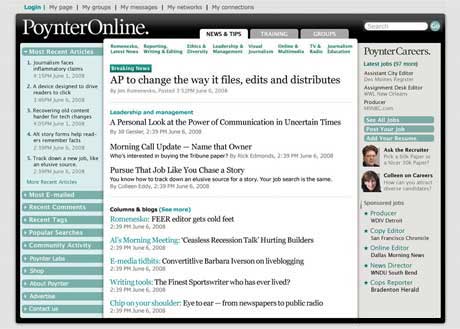
Poynter Online released a preview of its redesigned homepage – which is a typographical tour de force – on August 15. Later that day, a group of outside experts from editorial and advertising made the following recommendations.
According to Andrew Small, New Media Director at The Wilson (NC) Times, “I'd have to agree with this assessment. It seems as if there's a ton of redundancy on the page. Seems to be a consistent behavior with web design and ignorance of the average surfer – who, most likely, knows how to navigate a site without nine links to the same content on the home page. I don't even visit Poynter anymore…just read my Romenesko RSS.”
Poynter wants to hear what you think. You can post your comments about the redesign here.
Watch the video about the redesign.
Responses, below, are from Jeremy Gilbert, managing editor for innovation at Poynter Online and the designer of the new version of the site, and Bill Mitchell, director of Poynter Online since February 1999.
Enhance the user experience
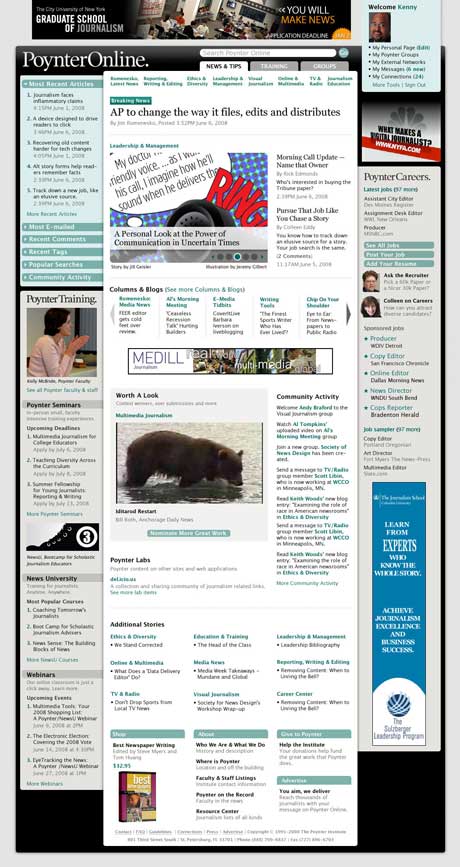
According to Poynter.org, "users value Poynter content highly, once they find it." This content would be easier find, and the site would be easier to navigate, if non-essential and duplicated content was eliminated, as follows:
Jeremy Gilbert: While we very much want to avoid slowing down or complicating the user experience, we have also learned that our users navigate through the site differently. We need to make sure that all users can find the content they need without trying to prescribe a single path.
Eliminate paid advertising
As a non-profit and the owner of Florida's largest newspaper, Poynter Online should get its financial suport from the St. Petersburg Times, rather than through paid advertising. However, if Poynter Online needs paid advertising, then it should promote alternatives to inherently awkward 728x90 leaderboards and antiquated 468x60 leaderboards. Experts agree that these ad formats will be replaced by more effective configurations relatively soon. Different configurations could promote more effective advertising strategies for all sites, as well as Poynter's.
Bill Mitchell: Before adding advertising to Poynter Online in 2006, we examined a variety of issues related to our non-profit status and the possible impact of advertising on the site. We concluded that both display and help-wanted advertising could become appropriate sources of revenue for Poynter Online, and that advertising could add valuable content as well as revenue to the site. The St. Pete Times remains Poynter's major source of revenue, but failing to generate additional sources, especially in these times, would not be smart. We recognize, as do most sites, that the design and color of some ads don't fit especially well with our overall presentation. We're committed to helping advertisers create effective ads, and to simplify the process as much as possible by sticking to the size and standards of the Internet Advertising Bureau.
Eliminate duplicate links
Journalists live by Romenesko, but links to his column appear three times in the prototype. One easy-to-find link would be more effective. Other links that appear two or more times include Training, Groups, Ethics & Diversity, Online and Multimedia, TV & Radio, Leadership & Management, Visual Journalism and Education. The three major tabs at the top and the other tabs in the lower left corner provide sufficient access to all the content at the site.
Jeremy Gilbert: Because Romenesko covers so many facets of the media industry, some stories may appeal to more segments of our audience than others. Because of that, we not only link to his blog more than once but deliberately make available multiple headlines from his blog to help users decide what they want to read.
Eliminate elements that visually compete with search
Users should not need to search for the search box. The easiest way to make search stand out is to eliminate visual distractions.
Jeremy Gilbert: We could not agree more. That's why if you compare the redesigned site to the existing Poynter Online you will find the search box more prominent and much longer. That way it will be easier to locate the search box and easier to search for the content you need.
Eliminate all unnecessary graphics and images
Most online information is processed by reading. Photos and illustrations that don't advance the content are unnecessary. The images that remain become much more powerful and effective.
Jeremy Gilbert: Photos and illustrations can be an important part of any user's experience with a Web site. Some things are more easily seen than read. We try to strike a balance with our use of visuals and text. We have tried to simplify the number of graphic images on the page both to speed up page loads and to emphasize the remaining images.
Eliminate scrolling by limiting the homepage to a single screen
The homepage should be a table of contents for the site, rather than a synopsis of all its content.
Jeremy Gilbert: This is an interesting idea, we would be interested in seeing sites that have successfully implemented this approach.
Eliminate mug shot of the logged-in user
Everyone isn't as handsome as Ken Irby. The last thing we want to see is our own ugly mug staring back at us when we log in.
Jeremy Gilbert: Any user has the choice not to upload his or her photo. We are hoping to emphasize the ability to personalize your Poynter Online experience and to participate in our online community.
Emphasize Poynter Careers
With so many layoffs recently, journalist need to know where the jobs are. Poynter isn't likely to give up the revenue these paid listings generate, so it should make the most of them by giving them an exclusive panel on the page.
Bill Mitchell: We agree that journalists not only need to know where the jobs are but how they might create new ones. We believe Poynter Careers gets prominent display on the page, filling what already appears to us as "an exclusive panel on the page". We're also working on an initiative aimed at beefing up what we offer in this area: http://www.poynter.org/standingup.
|



